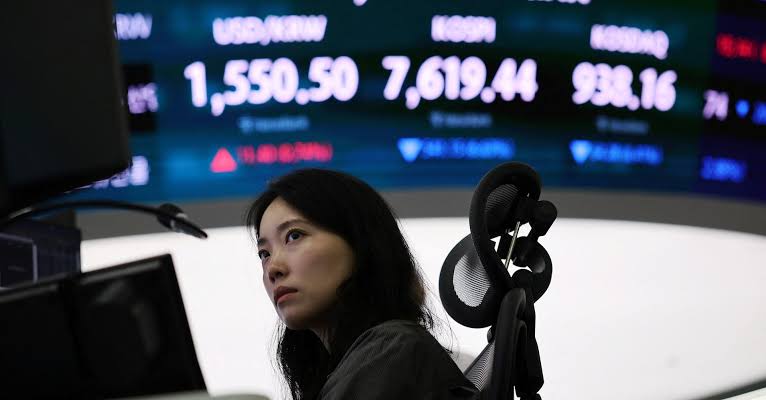
South Korea's benchmark KOSPI stock index fell more than 5% on Wednesday, dropping more than 20% from a record close in late June and signalling that the market is in bear territory. The KOSPI (.KS11), opens new tab closed 409.52 points, or 5.35%, lower at 7,246.79, its lowest close since May 20, as sharp swings in chipmaker stocks over AI worries and growing concerns about risky investment products rattled investors. Make sense of global markets with the Trading Day newsletter.
The index is now down more than 20% from its record close of 9,114.55 on June 22, a threshold commonly considered to confirm a bearish market. Trading was choppy on Wednesday, with the index opening lower before rebounding to rise as much as 1.8%. It then fell as much as 6.1%, triggering a "sidecar" trading curb that temporarily halted algorithmic trading. Chipmaker Samsung Electronics (005930.KS), opens new tab fell 6.3% and peer SK Hynix (000660.KS), opens new tab lost 5.7%, after U.S. semiconductor stocks slumped overnight, with the Philadelphia Semiconductor Index (.SOX), opens new tab dropping 4.7% as investors questioned whether AI-related spending could be sustained. "There seems to be spill-over effects from a slump in the previous session, which came despite Samsung Electronics' strong earnings, while there are worries about a slowdown in memory price growth and uncertainty over an earnings 'peak-out,'" said Han Ji-young, an analyst at Kiwoom Securities.
South Korean Finance Minister Koo Yun-cheol pledged to closely monitor risk factors that could heighten stock market volatility, citing worries about recently introduced single-stock leveraged exchange-traded funds (ETFs) linked to chipmaker stocks. On Tuesday, the KOSPI closed 4.9% lower after triggering a circuit breaker for the sixth time this year and the 12th in history. "Supply-demand dynamics of the dollar-won market are expected to shift in the second half," Deputy Finance Minister Moon Ji-sung said, adding that pressure from foreign investors taking profits and rebalancing should ease going forward. Moon pointed to won demand from an upcoming U.S. share sale by SK Hynix, which is set to be one of the world's largest new share sales. On Wednesday, dollar-selling related to the U.S. share sale by SK Hynix emerged in the country's dollar-won forwards market, Reuters reported. Foreigners were net buyers of shares worth 335.9 billion won ($223.86 million) after 13 straight sessions of selloff. The won strengthened past the 1,500 mark and traded 1.2% higher at 1,498.5 per dollar on the onshore settlement platform