
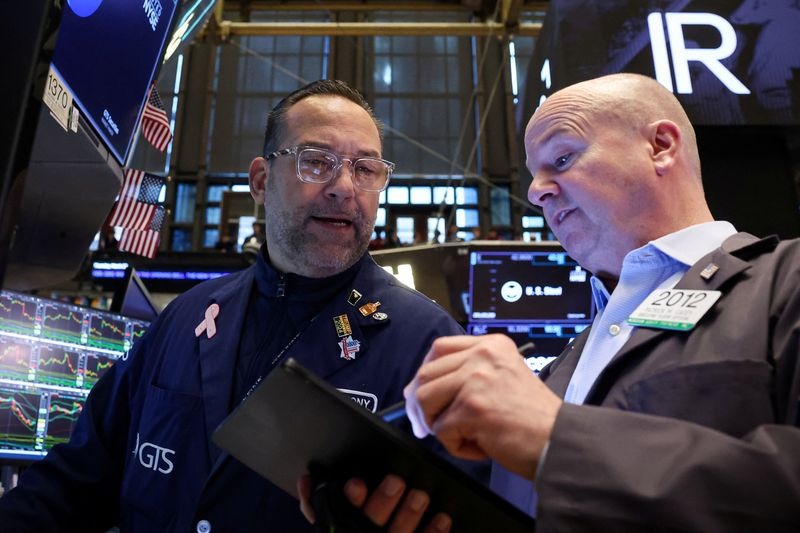
U.S. stocks ended in negative territory on Tuesday, though well off their session lows, as the widening conflict in the Middle East increased concerns of slowing economic growth. The retail sector was also in focus after healthy results from Target.
The benchmark S&P 500 index shed 0.9% to close at 6,817.13 points, having earlier cratered as much as 2.5%. The tech-heavy NASDAQ Composite declined 1% to settle at 22,516.69 points, paring a loss of as much as 2.7%. The blue-chip Dow Jones Industrial Average slid 0.8% to conclude at 48,501.27 points, pulling back from a fall of as much as 2.6%.
"A level of support around 6,780 for the S&P 500 index seems to be holding in today’s trading but its tentative. A break below that level invites prospects for a deeper dive, therefore, staying long but cautious seems the most (appropriate) approach right now," Mark Luschini, chief investment strategist at Janney Montgomery Scott, told Investing.com.
Get more insights on Wall St and the Middle Eastern conflict by subscribing to InvestingPro
Inflation concerns weigh on sentiment Sentiment has deteriorated, despite a mostly positive close for stocks on Monday, on concerns that the conflict in the Middle East is widening. A U.S. embassy in Saudi Arabian capital Riyadh was hit by Iranian drones, as were Amazon data centers in the UAE and Bahrain, as Iran retaliated by launching strikes across several neighboring countries.
The U.S. State Department said on Tuesday it has ordered the departure of non-emergency U.S. government personnel and family members from Bahrain, Iraq and Jordan.
The U.S. and Israel launched an air campaign against Iran on Saturday, striking Tehran and killing Iranian Supreme Leader Ali Khamenei. In response, Iran and its proxy Hezbollah retaliated, drawing the wider Gulf region into the escalating conflict.
Speaking at his first public event since the start of the attacks, President Donald Trump said "we’re already substantially ahead of our time projections," but noted that "whatever the time is, it’s okay."
"Whatever it takes," Trump said. He later claimed in a social media post that the U.S. has a "virtually unlimited" supply of some types of weapons.
The inflationary shock from the conflict is a major point of concern for investors, especially as oil prices rose sharply on concerns over supply disruptions. Markets fear that a sustained increase in oil could drive up inflation across the globe and elicit a more hawkish outlook from major central banks.
"The obvious risk is that oil prices are driven higher and persist at an elevated level long enough to harm U.S. and global economic activity. The other is whether this could metastasize into a broader conflict by drawing in China or Russia (which has its hands full at the moment with Ukraine) even on a somewhat covert basis," Janney Montgomery Scott’s Luschini told Investing.com.
The surge in oil prices have reinforced expectations that the Fed is unlikely to cut interest rates anytime soon. According to the CME FedWatch tool, the odds of a 25 basis point cut has now moved out to July.


