
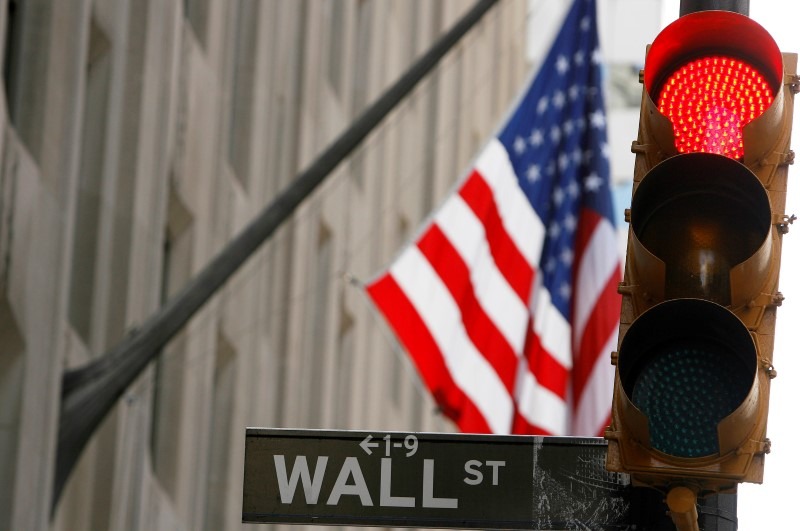
Wall Street ended mixed on Monday, completing a solid turnaround after sliding at the open. A rise in energy and technology stocks helped overcome a hit to sentiment from U.S. air strikes against Iran.
The benchmark S&P 500 closed a smidge higher at 6,879.33 points, having erased a decline of 1.2%. The tech-heavy NASDAQ Composite gained 0.4% to settle at 22,748.86 points, having reversed a fall of 1.6%. The blue-chip Dow Jones Industrial Average slipped slightly by 0.2% to conclude at 48,904.78 points.
"It absolutely amazes me how resilient U.S. markets are in the face of geopolitical risk. Having a full weekend to digest what was happening made a huge difference. In turns out that tech is the ultimate safety trade today along with gold, the dollar, and oil and defense names," Jake Dollarhide, CEO at Longbow Asset Management, told Investing.com.
Find out how to trade heightened AI uncertainty and geopolitical tensions by subscribing to InvestingPro
Trump lays out objectives The U.S. and Israel over the weekend launched a series of strikes against Iran, killing hundreds in the country, including Supreme Leader Ayatollah Ali Khamenei.
Iran retaliated by launching attacks on Israel and several other Middle Eastern countries, including Bahrain, Qatar, and the United Arab Emirates.
The development marked a major escalation in tensions between Washington and Tehran, especially after recent negotiations over Iran’s nuclear enrichment activities were largely inconclusive.
Markets were now fearful of an all-out war in the Middle East, especially as Iran vowed more retaliation for the recent attacks.
“We didn’t start this war but under President Trump we are finishing it,” Secretary of War Pete Hegseth said in a press conference at the Pentagon on Monday.
President Donald Trump later told reporters the operation had four objectives: the destruction of Iran’s missile capabilities, the annihilation of its navy, ensuring that the country can never get a nuclear weapon, and preventing Iran’s government from arming, funding, and directing terrorist activity.
"We’re already substantially ahead of our time projections, but whatever the time is, it’s okay. Whatever it takes," Trump said.
"We projected four to five weeks, but we have capability to go far longer than that," the president added.
"Scenes in the Middle East have caused widespread nervousness across financial markets. The U.S. attacks on Iran have caused oil prices to soar amid fears of disruptions to supplies, pushing up costs for businesses and consumers. That ranges from costing more to fill up the car to making it more expensive to run factories," Dan Coatsworth, head of markets at AJ Bell, said.
“If the issues persist then the market will start to worry about new inflationary pressures and that could lower expectations for near-term interest rate cuts. Central banks hold or raise rates in the fight to bring inflation lower," he said.
"While these scenarios will be front of mind, investors might be taking one day at a time while they try to ascertain if this is a short, sharp event or one that could drag on for ages," Coatsworth said.
“Staying calm and not making knee-jerk reactions to investment portfolios is important. There is no reason to panic and sell investments at the first sign of trouble. Equity markets are in the red following the weekend events, but they are only giving up a small portion of recent gains. History suggests that staying invested through both good and bad times is better than trying to time the market," he added.
Oil prices surge Oil prices surged after the weekend attacks, with the conflict set to shut off a major shipping channel – the Strait of Hormuz.
"How drawn‑out this conflict becomes – and its ramifications for trade and crude supply – remains uncertain. This could result in near-term market volatility," Afdhal Rahman, executive director of wealth advisory at OCBC, said in a mailed comment.
He noted that markets had mostly shrugged off the last major conflict between Israel, the U.S., and Iran in 2025, when Washington attacked Iran’s key nuclear facilities. Rahman said the speed at which that conflict was resolved was a major factor in its impact on markets.
Brent futures soared 7.6% to $78.41 a barrel, after earlier reaching its highest since January 2025, and U.S. West Texas Intermediate crude futures rose 6.5% to $71.36 a barrel, hitting its highest since June earlier in the session.


