
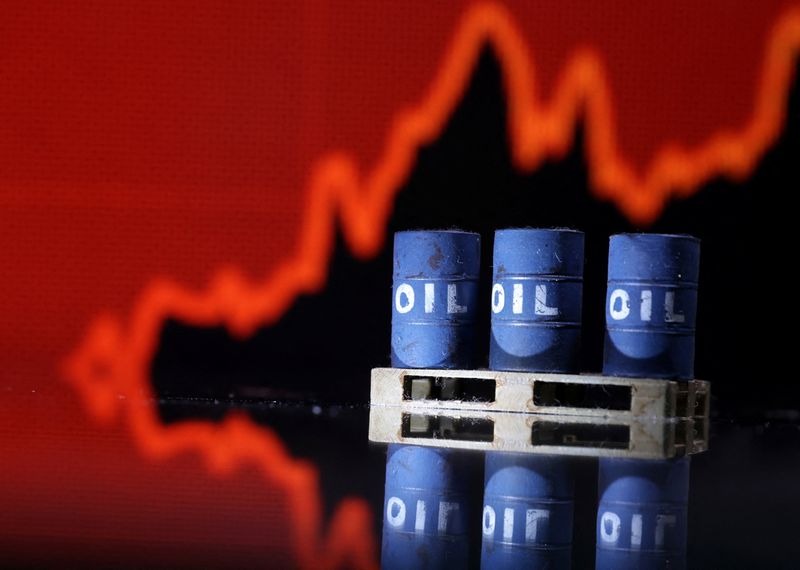
Oil prices could remain elevated in the near term following the latest Middle East escalation, with Texas Capital analysts warning of a potential short-term spike.
The brokerage firm said it expects crude to trade between $70 and $80 per barrel for at least this week after the United States and Israel launched coordinated strikes on Iran.
"We expect a potential price spike of up to $80/bbl over the next week due to the initial and continued U.S. and Israeli combat operations against Iran," analysts led by Derrick Whitfield said in a note on Sunday.
Dive deeper into crude oil prices outlook with InvestingPro Early market signals already reflect the heightened tension, with WTI trading above $72 per barrel, roughly 7% above Friday’s close. This move appears reasonable given its estimate that about $6 per barrel of geopolitical risk premium is already embedded in prices, the analysts said.
Despite the escalation, Texas Capital sees limited probability that Iran will successfully block the Strait of Hormuz for a prolonged period. The key shipping chokepoint carries more than 20% of the world’s seaborne oil supply and about 20% of global LNG flows. Iran has historically avoided closing the Strait due to the negative impact on its own exports.
Supply risks remain a central watchpoint. Iran is OPEC’s fourth-largest producer at roughly 3.3 million barrels per day, exporting about 2 million barrels per day, most of which goes to China. Texas Capital noted China has been stockpiling crude over the past year and could also draw on oil already on the water if disruptions emerge.
The analysts added that any sustained hit to Iranian exports could materially tighten balances, potentially shifting the 2026 market from a 2.7 million barrel per day surplus to roughly balanced in the second half of the year.
On the policy side, OPEC+ announced a 206,000 bpd production increase, though Texas Capital views the move as largely irrelevant given the group’s estimated 3.3 million bpd of effective spare capacity that could be brought online within 90 days.
On equities, the analysts said Iran’s military capabilities appear “materially degraded” after the strikes and believe Tehran’s retaliatory actions against Gulf infrastructure could further isolate the country and push it toward negotiations.
They expect the risk premium to remain elevated for at least one week, partly until Iran elects a new Supreme Leader and markets gain clarity on potential negotiations.
The firm expects intra-period crude volatility of plus or minus $5 per barrel driven by escalation headlines. In a higher and more persistent risk-premium environment, it favors oil-levered names including Chord Energy (NASDAQ:CHRD), California Resources Corp (NYSE:CRC), Riley Exploration Permian Inc (NYSE:REPX), Talos Energy (NYSE:TALO) and TXO Energy Partners (NYSE:TXO), noting that higher-levered companies have historically outperformed following sharp oil price increases.
In a more extreme scenario involving a disruption to shipping through the Strait of Hormuz, Texas Capital models oil rising toward $110 per barrel before easing as supply responses emerge. Still, the brokerage warned that geopolitical risk premiums typically fade quickly if physical crude flows remain largely unaffected.


