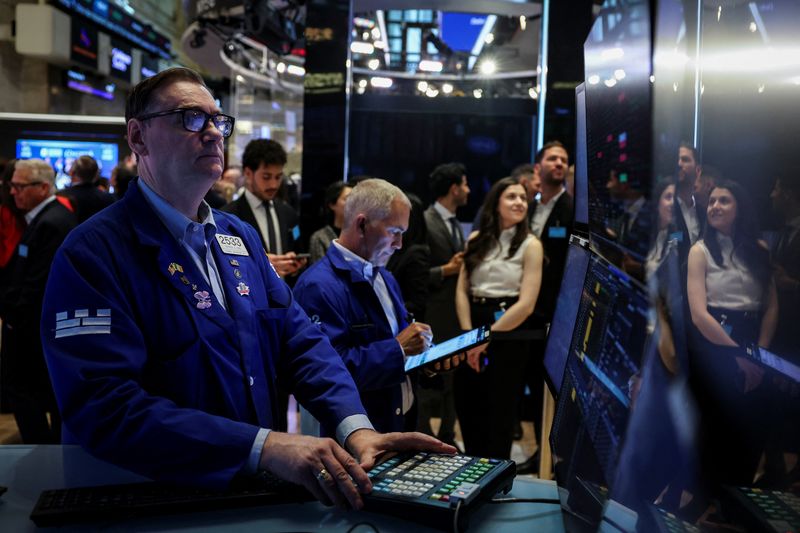
Wall Street ended lower on Tuesday, giving up gains from the morning, after media reports hinted at a breakdown in further peace talks between the U.S. and Iran.
The focus was also on a key Congressional confirmation hearing for Federal Reserve chair nominee Kevin Warsh, who called for "regime change" at the central bank and said he would uphold its independence if given the job.
The benchmark S&P 500 index shed 0.6% to close at 7,064.05 points, reversing course from a climb of as much as 0.4%. The tech-heavy NASDAQ Composite slipped 0.6% to settle at 24,259.96 points, erasing an advance of as much as 0.5%. The blue-chip Dow Jones Industrial Average fell 0.6% to conclude at 49,149.60 points, wiping out a rise of as much as 0.8%.
Get premium Wall Street insights with InvestingPro - now 55% off
Warsh calls for ’regime change,’ gets grilled over financial assets While developments in the Middle East continued to dominate headlines, market participants turned their attention toward Washington, where Kevin Warsh, President Donald Trump’s pick to become the next Federal Reserve Chair, spoke at a Senate confirmation hearing.
The event was closely watched amid concerns about the independence of the Fed following high-profile spats between Trump and current Fed Chair Jerome Powell.
In his prepared remarks before the U.S. Senate’s Committee on Banking, Housing, and Urban Affairs, Warsh said, if confirmed, he would ensure that the Fed’s conduct remained "strictly independent."
Trump earlier told CNBC that he would be "disappointed” if the new Fed chair does not cut rates. The president has long advocated for lower interest rates.
Warsh also called for "fundamental policy reforms" and "regime change in the conduct of policy" at the Fed, noting that the central bank was still dealing with a "legacy" of policy errors from 2021 and 2022. The former Fed governor said a new inflation framework was needed.
"Yields are jumping after Fed Chair nominee Kevin Warsh adopted a hawkish stance during today’s Senate hearing," José Torres, senior economist at Interactive Brokers, said. The benchmark United States 10-Year yield was last up 6 basis points to 4.311%.
"His opinion that the central bank’s post-pandemic policy errors directly raised price pressures well above the institution’s target further positions him as an inflation fighter who isn’t afraid to tighten financial conditions. The comments have fixed-income watchers doubtful about a cut this year, as there is only a 30% chance of a reduction before January," Torres added.
Warsh was also subjected to grilling about his financial assets at the hearing, in particular from U.S. Senator Elizabeth Warren. Last Tuesday, public financial disclosures showed that Warsh alone held assets worth about $135 million to $225 million, including holdings listed in two funds valued at over $50 million.
Talks at a standstill after Vance’s trip to Pakistan called off Turning to the Middle East conflict, uncertainty continued to grow over the fate of more peace talks between the U.S. and Iran. Wall Street initially opened higher and held on to those gains in the morning amid elevated hopes for a deal, but then the mood quickly changed towards noon.
"The primary catalyst for the market weakness emerging was the media reports that Vice President Vance has stayed in Washington, D.C. and has not departed to Pakistan for peace talks with Iran," Michael O’Rourke, chief market strategist at Jones Trading, told Investing.com.
"Subsequently, Iran has stated that the U.S. needs to lift the blockade before peace talks can resume. With the President stating he does not want to extend the ceasefire, investors are waiting to see if peace progress emerges before tomorrow evening’s deadline," O’Rourke added.
The New York Times reported that Vance was supposed to fly to Islamabad in Pakistan for more talks, but the trip was now on hold after Tehran failed to respond to U.S. negotiating positions, citing a U.S. official with direct knowledge of the matter.
Meanwhile, Iran’s Fars News Agency said the country was yet to decide on attending the talks, citing the foreign ministry’s spokesperson. State media also said that Tehran wanted the U.S. to lift its blockade on vessels entering and exiting Iranian ports before peace talks could restart.
Just ahead of the closing bell, Iran’s Tasnim News Agency said Iran would not attend the talks, citing an Iranian official. Soon after, the Associated Press said Vance had called off his trip, citing a U.S. official.
The apparent breakdown over the talks comes as the expiry of a two-week ceasefire between the U.S. and Iran looms large. The pause is due to end at an unspecified time later this week, although it remains uncertain whether both sides will agree to extend the halt. Further imperiling the fragile truce was the U.S. seizure of an Iranian-flagged cargo ship, which led to a threat of retaliation from Tehran.