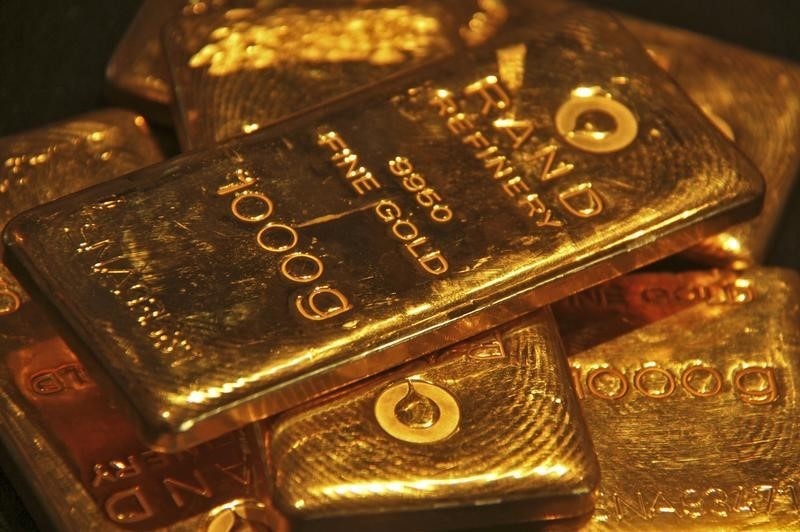
Gold prices fell in Asian trade on Thursday, sinking back into a trading range seen for more than a week as few signs of de-escalation in the U.S.-Israel war with Iran spurred flows into oil and the dollar.
While bullion continued to flit between the $5,000-$5,200 an ounce level, it still remained relatively upbeat, as concerns over the war kept some haven demand in play.
Spot gold fell 0.6% to $5,147.05/oz by 01:33 ET (05:33 GMT), while gold futures fell 0.5% to $5,151.86/oz.
Get more key insights on gold prices by subscribing to InvestingPro
Gold falls as Iran conflict spurs inflation fears, boosts dollar Weakness in gold came as continued hostilities between the U.S., Israel, and Iran kept market focus squarely on the dollar and oil.
The dollar index rose 0.2% in Asian trade and was close to a two-month high.
Oil prices jumped sharply on Thursday, briefly rising past $100 a barrel after media reports said two international oil tankers had been struck near Iraq. Other reports showed Oman evacuating a key oil export terminal, while Iran was seen blocking the Strait of Hormuz-- a key supply channel for roughly a fifth of the world’s oil.
Higher oil prices kept markets largely on edge over a long-term increase in inflation. This in turn fueled concerns over more hawkish central banks in the coming months– a scenario that bodes poorly for gold.
Other precious metals retreated on Thursday. Spot silver fell 0.2% to $85.5635/oz, while spot platinum fell 0.1% to $2,167.26/oz.
Mixed signals on the Iran conflict also spurred a whipsaw performance in metal markets this week. U.S. President Donald Trump and other officials repeatedly insisted that the Iran war was close to ending, despite continued hostilities between the U.S., Israel, and Iran.
In-line Feb CPI offers few cues, PCE inflation data awaited
Gold had briefly broken above $5,200/oz on Wednesday, but fell back below the level after the release of U.S. consumer price index inflation data.
While the print read in line with expectations, it did little to dispell concerns over a future, energy-driven increase in price pressures.
Focus this week is squarely on PCE price index data for January, due on Friday, for more decisive cues on inflation.
The print is the Federal Reserve’s prefered inflation gauge, and is likely to factor into long-term expectations for inflation.
While the PCE data is unlikely to reflect energy price shocks from the Iran conflict, it is expected to offer more cues on the world’s largest economy in the first month of 2026.