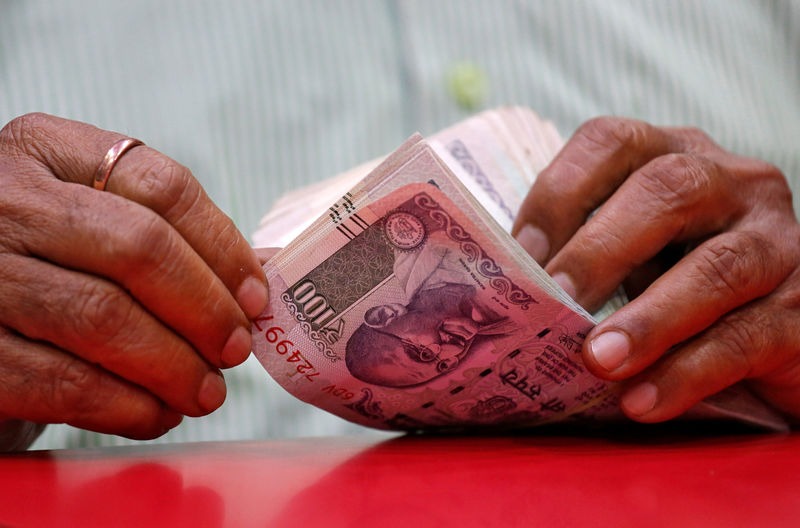
Most Asian currencies extended losses on Wednesday as investors grappled with an intensifying Middle East conflict, surging oil prices and a broadly stronger U.S. dollar, while the Indian rupee sank to a record low.
The US Dollar Index closed 0.6% higher overnight and ticked 0.1% higher in Asian trade amid a widening conflict between the U.S., Israel, and Iran.
US Dollar Index Futures edged 0.2% higher as of 00:24 ET (05:24 GMT).
Traders assess impact of oil price surge The geopolitical crisis, triggered by coordinated U.S. and Israeli strikes on Iran over the weekend and followed by Iranian retaliation, has threatened key energy flows through the Strait of Hormuz, stoking fears of prolonged supply disruptions.
Brent crude prices have rallied sharply on these risks, surging as much as 14% since last Friday.
The spike in oil has fuelled fears of higher inflation globally and eased bets on imminent Federal Reserve rate cuts.
"Asian currencies are increasingly caught in the crosscurrents of higher oil prices, a stronger US dollar, and deteriorating risk sentiment," an ING analyst said in a note.
Indian rupee hits record low The Indian rupee fell to record lows, with the USD/INR pair rising 0.3% 92.325 rupees, pressured by spiralling crude import costs and capital outflows.
The currency was set for its fifth consecutive session of depreciation.
The South Korean won's USD/KRW pair traded flat after surging nearly 2% overnight.
The Bank of Korea said on Wednesday it will closely watch if won exchange rates and bond yields deviate excessively from domestic fundamentals, even with external factors in consideration.
The Japanese yen's USD/JPY pair edged down 0.2% but remained near 5-week highs touched in the previous session.
The Singapore dollar's USD/SGD pair edged up 0.1%, extending gains.
Australia's hot GDP, China's divergent PMI data in focus Domestic data offered mixed signals. Robust Australia GDP data, with annual growth accelerating to around 2.6% and quarterly expansion ahead of expectations, reinforced expectations of further Reserve Bank of Australia (RBA) rate hikes.
Still, the Australian dollar's AUD/USD slipped 0.6%, in line with the broader trend.
In China, official PMI readings showed factory activity in contraction, while private-sector surveys from RatingDog PMI reported above-expectation expansionary conditions, highlighting divergence in the economy’s pulse.
The Chinese yuan's onshore pair USD/CNY gained 0.3%, set for its fourth straight day of gains.