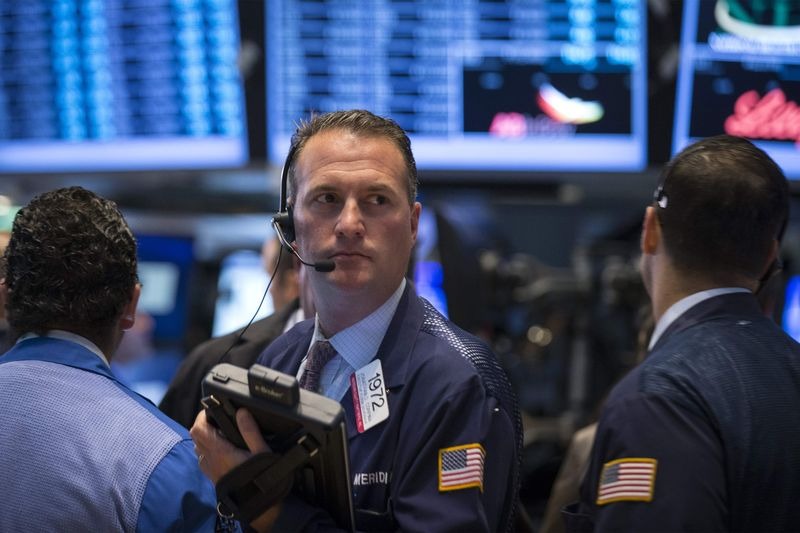
U.S. stocks ended in the red on Friday, as continued weakness in the technology sector along with hotter-than-expected producer inflation data weighed on sentiment. Wall Street also slid to its worst monthly performance since March last year.
The benchmark S&P 500 index fell 0.5% to close at 6,877.36 points, the tech-heavy NASDAQ Composite shed 0.9% to settle at 22,668.21 points, and the blue-chip Dow Jones Industrial Average slid 1.1% to conclude at 48,977.18 points.
Get top analyst picks and key stock insights by upgrading to InvestingPro
Nvidia (NASDAQ:NVDA), the most valuable company in the world, was the biggest weight on Wall Street on Thursday, sliding over 5% despite logging bumper quarterly earnings.
Questions over more shareholder returns, especially after a sharp increase in the company’s cash balance, weighed on the stock, as did some profit-taking after a strong run-up ahead of its earnings.
Wall Street posts worst month since March The benchmark S&P 500 index notched its worst monthly performance since March last year. For February, the gauge was down 0.9%. The Nasdaq also achieved the same milestone, down 3.4% for the month. The Dow managed to eke out a monthly gain of 0.2%.
It’s been a turbulent February for Wall Street, which historically has been a weak month for markets. Sentiment came under pressure from a host of drivers such as geopolitical tensions, trade developments, and a changing perspective about artificial intelligence and its disruptive capabilities.
"Throughout the month, two bearish AI themes have weighed on investors. The first was the AI disruption risk of software and other services. The second is the hyperscalers cannibalizing their free cash flow for the sake of AI capex," Michael O’Rourke, chief market strategist at Jones Trading, told Investing.com.
"Neither of these risks appears ready to fade any time soon," he added.
Still, according to Brent Schutte, chief investment officer at Northwestern Mutual Wealth Management, the month also showed a broadening, as investors rotated out of technology stocks and into other sectors and areas of the market.
"Stubborn inflation remains a key risk to future interest rate movements throughout the remainder of the year, underscoring the delicate balance of the economy and markets," he said.
"That said, we continue to believe that AI is poised to increase the productivity and profitability of a broad swath of companies in the coming years, much like the internet did at the turn of the century. Equity markets are poised to pivot from a heavy dependence on AI and the tech sector to a more balanced showing from a broader set of companies benefiting from the improving health and diversification of the overall economy," Schutte added.
Netflix declines to raise Warner Bros offer On Friday, Netflix (NASDAQ:NFLX) was in the spotlight, soaring around 14% after the streaming giant said it will not raise its offer for Warner Bros Discovery (NASDAQ:WBD).
This was after Warner determined an upgraded, $31 a share offer from Paramount Skydance (NASDAQ:PSKY) was the superior proposal. Paramount stock jumped almost 21%, while Warner was down about 2%.
Netflix said that with the price required to match Paramount’s latest offer, the deal was “no longer financially attractive.”
Still, the streaming giant is set to receive $2.8 billion as a termination fee from Paramount if Warner picks the latter. Warner shareholders are set to vote on the Netflix deal on March 20.
Netflix declining to further pursue Warner marks a potential end to one of the largest high-profile bidding wars in the media industry. The streaming giant and Paramount had aggressively pursued Warner, with its studio assets and host of popular franchises being viewed as highly attractive.
Elsewhere, Dell Technologies (NYSE:DELL) advanced about 22% after the PC maker delivered record quarterly results on the back of surging AI server demand.
Block (NYSE:XYZ) stock soared around 17% after the payments firm said it will slash cut over 4,000 jobs, nearly half its workforce, as part of an overhaul to embed artificial intelligence across its operations.
January producer inflation comes in hot On the economic calendar, January’s producer price index ticked up 0.5% M/M and 2.9% Y/Y, both higher than the consensus figures of 0.3% and 2.6%, respectively.
Meanwhile, core PPI, which excludes energy and food prices, rose 0.8% M/M and 3.6% Y/Y, compared to estimates of 0.3% and 3.0%.