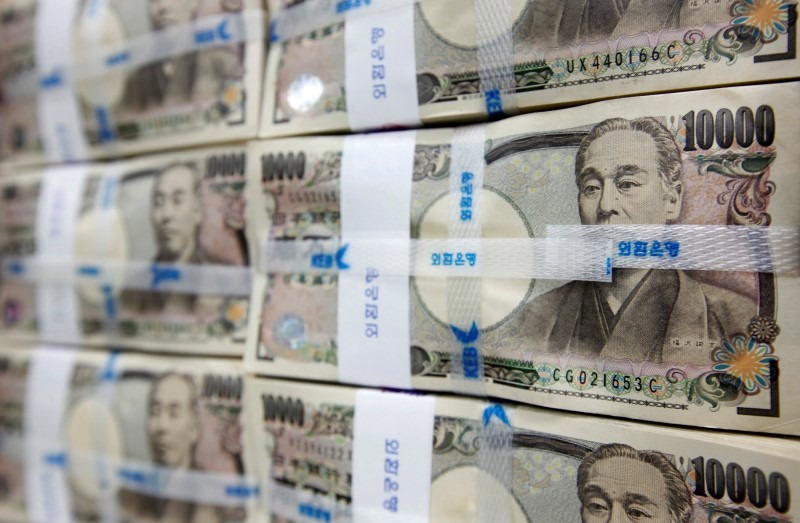
Most Asian currencies kept to a tight range in holiday-thinned trade on Monday as the dollar steadied after mixed consumer inflation data, while the Japanese yen weakened after dismal economic growth data for the fourth quarter.
Market holidays in China, Taiwan, and South Korea kept regional volumes thin, while the dollar also moved little with U.S. markets closed on Monday.
Get more price insights on Asian currencies by subscribing to InvestingPro
Japanese yen weakens on soft Q4 GDP The Japanese yen’s USD/JPY pair rose 0.2% after gross domestic product data showed the economy grew substantially less than expected in the fourth quarter.
The weak GDP print was driven chiefly by softer-than-expected business spending, while export growth and private consumption also remained on the backfoot.
Monday’s data indicated that fiscal stimulus passed in late-2025 had done little to spur growth so far, and that Prime Minister Sanae Takaichi will likely have to unlock more spending to boost growth.
Takaichi is viewed as having a clear legislative path towards unlocking more fiscal spending after her ruling coalition won a supermajority in Japan’s lower house.
But concerns over stretched fiscal spending are expected to weigh on the yen. Weakness in the Japanese economy also diminishes the prospect of more interest rate hikes by the Bank of Japan.
Dollar steady after mixed CPI; more cues awaited The dollar index and dollar index futures moved little in Asian trade on Monday, retaining a bulk of their losses from last week.
The greenback showed limited reaction to mixed consumer price index inflation data for January, released on Friday. While headline inflation grew slightly below expectations, core CPI was in line with forecasts.
The dollar was nursing losses from last week as uncertainty over the long-term outlook for interest rates, especially with an upcoming leadership change at the Federal Reserve, kept traders averse towards the dollar. A deep sell-off in U.S. equities also pressured the dollar.
Still, OCBC analysts noted that more pronounced weakness in the dollar appeared less likely, especially if more U.S. macroeconomic data read positive.
“If signs of easing US wage and inflation pressures persist, long‐end Treasuries could regain hedge value against growth risks, helping restore some of the USD’s safe‐haven appeal. This should keep any additional USD downside shallow,” OCBC analysts said.
Focus this week is on more key U.S. economic readings, including industrial production, trade, and most importantly, PCE price index data. The print is the Fed’s preferred inflation gauge.
The minutes of the Fed’s January meeting are also due this week.
Broader Asian currencies moved little in holiday-thinned trade. The Australian dollar’s AUD/USD pair rose 0.2%, remaining close to three-year highs following a host of hawkish signals from the Reserve Bank last week.
The Indian rupee’s USD/INR pair rose 0.2% to near 90.7 rupees, while the Singapore dollar’s USD/SGD pair rose slightly after non-oil exports data read weaker than expected for January.